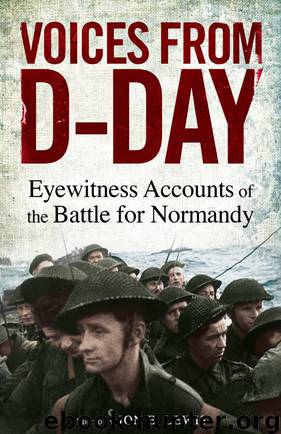
Voices from D-Day by Jon E. Lewis
Author:Jon E. Lewis
Language: eng
Format: epub
ISBN: 9781472103994
Publisher: Constable & Robinson
Soldiering On
Combat, Life and Death in the
Battle of Normandy,
7 June – 20 August 1944
Sometimes I wondered if the battles would ever end. We seemed to be fighting all day, every day. We couldn’t see an end to it.
Trooper Peter Davies, 1st East Riding Yeomanry
Everyone who took part in the Battle of Normandy that summer was struck by the particular loveliness of the countryside they marched and fought through. Its hedges, orchards and meadows were almost a painful reminder of home for the men from England’s shires, while Americans were struck by its verdancy.
Ernie Pyle, war correspondent
29 June 1944
All the American soldiers here are impressed by the loveliness of the Normandy countryside. Except for swampy places it is almost a dreamland of beauty. Everything is green and rich and natural looking.
There are no fences as such. All the little fields are bordered either by high trees or by earthen ridges built up about waist-high and now after many centuries completely covered with grass, shrubbery, ferns and flowers.
Normandy differs from the English landscape mainly in that rural England is fastidiously trimmed and cropped like a Venetian garden, while in Normandy the grass needs cutting and the hedgerows are wild, and everything has less of neatness and more of the way nature makes it.
Yet, if it was beautiful, the Normandy landscape was also deadly. The bocage, with its medievally small meadows and high farm hedges, was the perfect defensive country, where every hedge could hide a tank, every roadside ditch a heavy machine gun. The bocage was perhaps densest in the American sector, the Cotentin and the western half of Normandy. To fight in the hedgerows took a special kind of combat.
Anonymous US Infantry Officer
I want to describe to you what the weird hedgerow fighting in northwestern France was like. This type of fighting was always in small groups, so let’s take as an example one company of men. Let’s say they were working forward on both sides of a country lane, and the company was responsible for clearing the two fields on either side of the road as it advanced. That meant there was only about one platoon to a field, and with the company’s understrength from casualties, there might be no more than twenty-five or thirty men.
The fields were usually not more than fifty yards across and a couple of hundred yards long. They might have grain in them, or apple trees, but mostly they were just pastures of green grass, full of beautiful cows. The fields were surrounded on all sides by the immense hedgerows – ancient earthen banks, waist high, all matted with roots, and out of which grew weeds, bushes, and trees up to twenty feet high. The Germans used these barriers well. They put snipers in the trees. They dug deep trenches behind the hedgerows and covered them with timber, so that it was almost impossible for artillery to get at them. Sometimes they propped up machine guns with strings attached so that they could fire over the hedge without getting out of their holes.
Download
This site does not store any files on its server. We only index and link to content provided by other sites. Please contact the content providers to delete copyright contents if any and email us, we'll remove relevant links or contents immediately.
The Radium Girls by Kate Moore(12028)
100 Deadly Skills by Clint Emerson(4925)
Rise and Kill First by Ronen Bergman(4788)
The Templars by Dan Jones(4689)
The Doomsday Machine by Daniel Ellsberg(4490)
The Rape of Nanking by Iris Chang(4213)
Killing England by Bill O'Reilly(4001)
Stalin by Stephen Kotkin(3965)
Hitler in Los Angeles by Steven J. Ross(3946)
12 Strong by Doug Stanton(3550)
Hitler's Monsters by Eric Kurlander(3342)
Blood and Sand by Alex Von Tunzelmann(3203)
The Code Book by Simon Singh(3189)
Darkest Hour by Anthony McCarten(3133)
The Art of War Visualized by Jessica Hagy(3007)
Hitler's Flying Saucers: A Guide to German Flying Discs of the Second World War by Stevens Henry(2754)
Babylon's Ark by Lawrence Anthony(2678)
The Second World Wars by Victor Davis Hanson(2524)
Tobruk by Peter Fitzsimons(2517)
